

Mezzanine: Five perspectives on good acoustics
The new special issue from Hochparterre brings together five articles on room acoustics, material innovation, and the new SIA standard 181/1. An invitation to read—and to listen.
What makes a room a place where we enjoy working, eating, listening, or chatting? It's not just the light, the materials, or the proportions. It's also the sound. Or more precisely: the way a room handles sound.
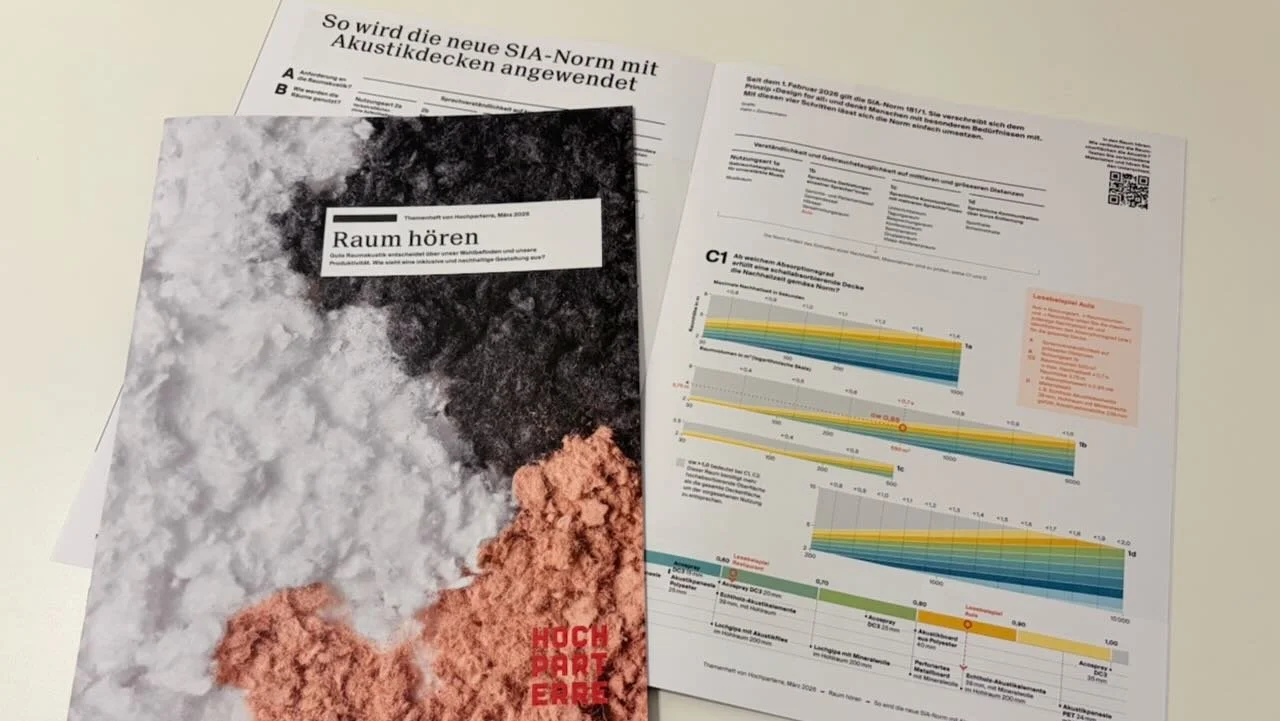
— Hochparterre special issue “Hearing Space” with five articles
Our special issue "Raum hören" (Hearing Space), which has just been published by Hochparterre, addresses this question. Five authors examine the topic of room acoustics from different perspectives, ranging from communication research and standardization to the history of materials. Here is a brief overview.
The Hochparterre special issue "Hearing Space" can be ordered free of charge as a print edition or read as an e-paper.
1: Listen to each other
Mikael Krogerus opens the issue with a surprising perspective: before we talk about reverberation times and absorption coefficients, we should think about listening itself. In his essay, he draws a line from the Babylonian confusion of tongues to three concrete findings from communication research that show how communication can be improved. A text that reminds us that good acoustics always serve human interaction.
→ To the article, reading time: 5 minutes
2: "Acoustics is not an exact science—that's what makes it so appealing."
In this interview, acoustician Clemens Kuhn-Rahloff explains why acoustic planning is much more than just meeting standards. He talks about cultural differences in sound insulation, the Lombard effect in restaurants, and why even quiet conversations can disrupt our concentration. Particularly exciting for planning: his classification of the new SIA standard 181/1 and its consistent approach to inclusion. Required reading for anyone who understands acoustics as a design task.
And, of course, I particularly like the following statement: "...there are three classic measures that are useful in most cases: background noise, partition walls, and a highly absorbent ceiling."
→ To the article, reading time: 8 minutes
3: How the new SIA Standard 181/1 is applied
SIA Standard 181/1 for room acoustics has been in force since February 1, 2026. For the first time, it focuses on inclusion and makes "design for all" the standard. Our infographic shows in four steps how the standard can be pragmatically implemented with highly absorbent acoustic ceilings – a compact guide for everyday planning.
→ To the infographic, reading time: 3 minutes
4 Old paper, new ceiling
Roderick Hönig, senior editor at Hochparterre, visits Acosorb in Hoofddorp near Amsterdam and accompanies a technician to the construction site. His report shows how recycled paper fibers are turned into highly absorbent ceiling coatings—from the mixing machine to the finished spray plaster. Four Swiss projects are also presented with acoustic measurement data: from the Studio Bar in Zurich to the offices of foryouandyourcustomers and the Holcim Campus in Zug.
→ To the article, reading time: 12 minutes
5 Material that can swallow up the room
Finally, Sabine von Fischer, architect and author ofDas akustische Argument (The Acoustic Argument), broadens the perspective. Her essay traces the more than 100-year history of sound-absorbing materials: from the first patents in the 1920s to the 32,000 absorber wedges in the Berlin War Laboratory to Le Corbusier's Philips Pavilion. It is a narrative that shows how the pursuit of acoustic control has always been a reflection of the times – and one that ends with a thought-provoking question: Where are the spaces in which an acoustic response is still welcome?
→ To the article, reading time: 10 minutes
The Hochparterre special issue "Hearing Space" can be ordered free of charge as a print edition or read as an e-paper.

Jonathan Möller
As someone who is almost deaf, the author knows how crucial room acoustics are for a good room and for good conversations.