

A space cannot not resonate.
"One cannot not communicate." This famous quote from Paul Watzlawick reminds us that we are always communicating. We should also be aware that no room is silent. Every room has an acoustic effect—always.
No one can escape the influence of room acoustics. It is an essential part of our environment and has a significant impact on our experience. This insight means that building owners, architects, planners, and landlords always play a role in shaping the sound of a room. And, as with communication, simply being aware of this effect can improve the result:
Rooms are composed more consciously and designed more thoughtfully.
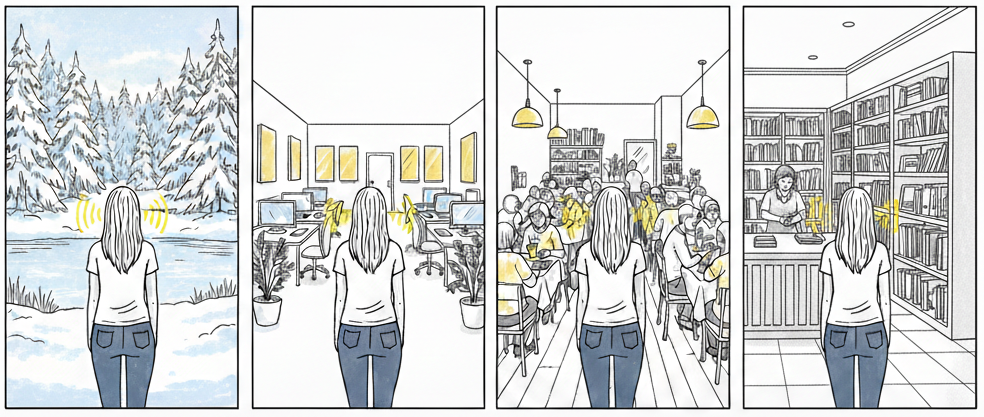
— No space can be without sound.
Speech intelligibility as a responsibility
At the same time, residents and users of spaces share responsibility. This is because we usually choose our environment ourselves: living space, workplace, or meeting place. We decide—consciously or unconsciously—for or against quality, including acoustic quality. Environment has an impact. And the environment is often chosen by ourselves.
However, not everyone can freely determine their acoustic environment:
Children have no influence on the acoustics of their daycare center or classroom.
Patients do not choose the treatment room.
Employees do not always use the conference room.
Citizens may not use the community center or auditorium for a meeting.
In addition, there are many people with an increased need for good speech intelligibility: people with hearing or speech impairments, with concentration difficulties, or those for whom Deutsch is Deutsch their native language. According to the Federal Statistical Office (FSO), this applies to one in three to four people in Switzerland. This is not a marginal group, and the proportion is increasing every year.
Builders, architects, planners, and landlords have a special obligation to these people.
SIA Standard 181/1 for room acoustics
This is precisely where the new SIA Standard 181/1 for room acoustics (sia.ch), valid as of today, February 1, 2026, comes in: It is a practical tool that reduces complex room acoustics to a few clearly defined reverberation times —differentiated according to room usage types and frequency ranges.
SIA Standard 181/1 is a standard that considers everyone—including people with increased speech intelligibility needs —such as the author of this blog post, who is severely hard of hearing.
To ensure that this standard remains understandable in planning and communication, we have developed our reverberation app. It makes room acoustic measures clear, discussable, and tangible —for everyone involved.
Since rooms always have an acoustic presence, we should design them with the utmost care.

Jonathan Möller
As someone who is almost deaf, the author knows how crucial room acoustics are for a good room and for good conversations.
Want even more inspiration for good conversations?
When have you experienced listening being easy or difficult – because of the room?
How does design foster community?
When did you find the courage to break with expectations?
These and 97 other questions are inspired by personalities from the fields of architecture, acoustics, sustainability, art, and philosophy and come from our card set "100 good questions for 200 good conversations."